Louisiana Investigation of Deaths at Healthcare Facilities During Katrina
Five Days at MemorialLouisiana Investigation of Deaths at Healthcare Facilities During Katrina began as a broad inquiry into why patients died in hospitals and nursing homes during Hurricane Katrina, then acquired an unexpected criminal dimension when investigators received an allegation of suspicious drug administration to patients at Memorial Medical Center. Led by prosecutor Butch Schafer and Special Agent Virginia Rider, the inquiry examined both institutional failures and possible individual crimes. Its central challenge was to distinguish what witnesses reported, what postmortem tests established, and what either could prove about the causes and circumstances of death.
Scope and mandate
The investigation took shape amid accounts of deaths throughout the flooded region. At St. Rita’s Nursing Home, more than thirty residents had apparently drowned. The unfolding tragedy prompted questions about whether deaths reflected the storm and a chaotic government response, weak flood protection, inadequate preparation or oversight, or decisions by facility leaders not to evacuate before the storm. Investigators also considered whether emergency plans had been followed and whether facilities had made necessary preparations.
Schafer began pursuing these questions after returning home from mourning his daughter. An experienced prosecutor specializing in complex cases, he worked under Louisiana Attorney General Charles Foti. Foti publicly pledged a full investigation of the deaths at St. Rita’s, and the Medicaid Fraud Control Unit opened inquiries into every hospital and nursing home where patients had died. The unit’s authority extended to healthcare facilities participating in Medicaid, placing Memorial’s corporate owners under government scrutiny.
At first, the inquiry appeared capable of establishing whether Memorial had followed its disaster plan and, if so, whether responsibility for the deaths lay elsewhere. The city’s pre-storm evacuation order had not applied to hospitals, which had been ordered to remain open and staffed. But when an investigator requested a list of deceased patients and a copy of Memorial’s plan, a Tenet attorney asked that the questions be put in writing. The company then supplied a corporate account, news coverage emphasizing employees’ efforts, and press releases attributing deaths to conditions during the crisis, including loss of power, air-conditioning, and running water.
The allegation at Memorial
A day after Tenet’s response, an attorney for LifeCare Hospitals of New Orleans reported that nine LifeCare patients on Memorial’s seventh floor had died in suspicious circumstances. The attorney said the patients had been given morphine by a physician, identified in the report as Dr. Poe, when evacuation appeared unlikely. The allegation was startling to the Medicaid Fraud Control Unit: intentional killings at healthcare facilities were almost unheard of in its work, and even deaths associated with abuse were rare.
Schafer and Rider treated the claim as something that required investigation, not as a conclusion. LifeCare witnesses gave accounts that supported one another, alleging that Anna Pou had come to the seventh floor to end the lives of the nine surviving patients; two said she had directly described her intention as lethal. All nine patients had died. The investigators still needed to determine whether the alleged plan had been carried out, why, who else had participated, and whether physical evidence could corroborate the accounts.
Rider therefore sought a broad set of materials that included medical records for the deceased, evacuation plans, computer hard drives, employee contacts, pharmacy records, and medical waste that might contain discarded vials or syringes. Because investigators expected the hospital would not consent to a search, Schafer and Rider sought a warrant. Rider prepared an affidavit based on accounts from witnesses including Diane Robichaux, Therese Mendez, Kristy Johnson, and Steven Harris. The application sought evidence necessary to prove second-degree murder, a charge whose Louisiana definition included a specific intent to kill. Investigators did not plan to pursue the death penalty; manslaughter or negligent homicide remained possible lesser charges.
Search and collection of evidence
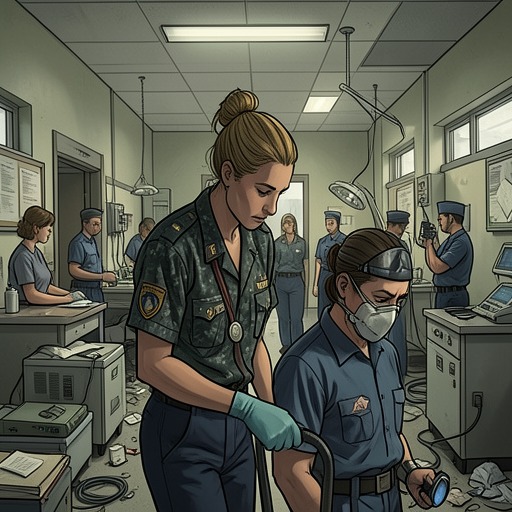
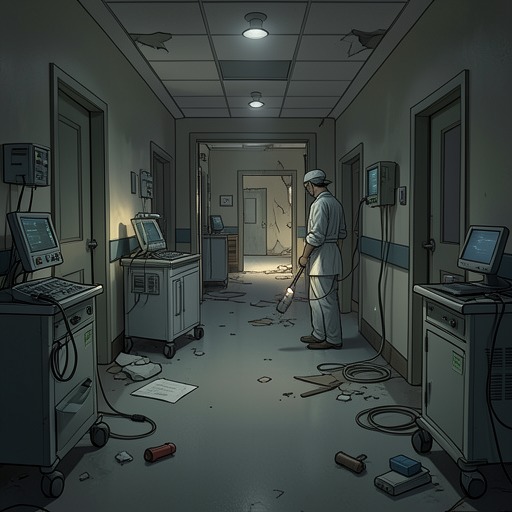
After a judge granted the warrant, Rider and Schafer returned to Memorial on October 1 with twenty-two special agents, including investigators from the Medicaid Fraud Control Unit and the U.S. Department of Health and Human Services Office of the Inspector General, as well as two Louisiana State Police crime-scene investigators. The hospital still had no electricity, and its size—two city blocks—made the search difficult. Federal public-health experts assessed the air before the agents entered. The investigators searched a hot, dark building for records and other evidence; Rider, who had high blood pressure and was out of shape, left the seventh-floor search to colleagues.
The investigators also had to establish when patients had died. Memorial pathologist John Skinner and laboratory director David Heikamp had walked the hospital after the evacuation to record the dead and their locations, at the request of medicine chairman Richard Deichmann and chief executive René Goux. Their notes and recollections later became important to reconstructing the sequence of deaths. Separately, a LifeCare witness, Kristy Johnson, described seeing a nurse inject Rose Savoie, a ninety-year-old patient with acute bronchitis and kidney problems. Johnson said Savoie had complained that the injection burned; Savoie died that afternoon, as did the other remaining LifeCare patients. The investigators regarded Johnson as an eyewitness to the seventh-floor events.
Forensic findings and dispute
The condition of the bodies threatened to limit what forensic examination could establish. Orleans Parish coroner Frank Minyard initially told Rider that the bodies had decomposed in the heat for more than a week and that blood testing for lethal drug levels would not be possible. A volunteer pathologist advised that drugs might remain detectable in more durable tissues or abdominal fluid. Minyard then agreed to request autopsies and tissue samples from patients who had died in Orleans Parish healthcare facilities after the storm, an effort that initially encompassed about one hundred people. On September 22, investigators sent samples from eighteen Memorial bodies to National Medical Services, Inc., in Pennsylvania for toxicology testing.
In an initial discussion of those eighteen cases, the laboratory director, Robert Middleberg, reported morphine in nine and midazolam in approximately five or six. Later, among forty-one Memorial and LifeCare bodies tested by the laboratory, twenty-three were positive for morphine, midazolam, or both. Those findings were significant to investigators, but they did not by themselves resolve the cause of any individual death. Postmortem tissue results were harder to interpret than blood tests in living patients, and heat exposure could have altered drug concentrations. Experts considered whether the drugs represented a single large dose or accumulated doses, whether patients’ kidney or liver problems affected drug processing, and whether drug effects were consistent with the known timing of deaths.
The disagreement became especially sharp over how much could be inferred from the concentrations. Steven Karch, consulted by Minyard, argued that drug levels in bodies exposed to high temperatures for days could not reliably establish the levels present before death and advised leaving causes undetermined. Michael Baden countered that uncertainty about dosage did not erase the finding that morphine and Versed were present shortly before death, and that he saw no competing cause of death. Cyril Wecht argued that some detected levels were exceptionally high; he also conducted a small, unpublished test comparing drug levels in refrigerated samples with samples subjected to hot, humid conditions. The test found no significant difference, but its limited scale and lack of independent scientific review left it as one piece of evidence rather than a definitive resolution.
Memory, method, and unresolved questions
As reports of the allegations appeared in the media, the investigation faced a second evidentiary problem: the possibility that publicity could affect recollection. Researchers had documented the fallibility of eyewitness memory, including the risk that later information and conversations among witnesses could alter what people remembered. Several LifeCare witnesses had discussed events after the evacuation and consulted a written timeline. Schafer, Rider, and their colleagues consequently sought additional witnesses while trying not to lead them or suggest details, and pursued contemporaneous physical and written records wherever possible.
The inquiry thus proceeded through different kinds of evidence that could not simply be treated as interchangeable. Witness accounts could describe actions and conversations; medical records and hospital notes could help establish treatment and timing; toxicology could establish drug presence while leaving questions about dose and causation; and expert disagreement exposed the limits of interpretation. A three-day meeting considered the forensic and medical evidence in detail, drawing on interviews, handwritten notes, charts, toxicology reports, autopsy reports, and death certificates. The investigation’s defining difficulty was not merely the scarcity of evidence, but the need to decide what each item could reliably establish without turning an allegation, a positive test, or an uncertain memory into proof of a different claim.